English
 Italiano
 Français
- INFO
- TEAM
- MULTIMEDIA
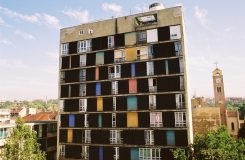
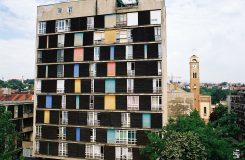
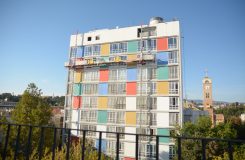
The Interdisciplinary Community Art Project (human-urban network) started in 2004. in order to restore commonly shared “spaces” of the residential building block in the Laginjina street 7 and 9 in Zagreb (elevators, facades, roof terraces, staircases, etc.), while reflecting on its tangible and intangible heritage as resources of sustainable renovation, maintenance and use.
Chronology of the project:
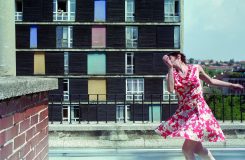
2003. – Preparation of the international interdisciplinary site-specific and community project “Vitić_dances”.
2004. – Croatian artist Boris Bakal (Shadow Casters) moved into the building and started a complex interdisciplinary endeavour (permanent artistic interventions and programs in and around the building, with consistent social engagement) while aiming to raise the public awareness of its tenants and local community.
2004. – Re-conceptualization of the project in order to save and restore this masterpiece of modern architecture that was in a deteriorating state and threatened the lives of its 256 inhabitants.
2004. – Working methods: open offices (a tent in the front of the building or in the neighborhood with activists and artists explaining the project and making enquiries).
2004./2005. -“Extended house council meetings” (architects, writers, artist acting as inhabitants and co-owners – using Augusto Boal’s theater of oppressed techniques).
2004./2007. – Creation of building’ history archive and activation of co-owners.
2004./2006. – Creation of human-urban interdisciplinary network (Shadow Casters with: co-owners, larger neighborhood community, city and state institutions, professional associations and non-profit organizatios, etc.)
2005. – Exhibition “Vitić _Dances”: a presentation of this multilayered project (Zagreb, Split, Rijeka).
2005. – Workshop “Vitić -Dances_ second_circle”: methodology of human-urban network (Zagreb, Split, Rijeka).
2005./2006. – Numerous multidisciplinary research programs, lectures, cultural & artistic activities (concerts, performances ) in and around the building.
2005./2008. – Creation of the building’s memory archive and the neighbourhood’s memory archive.
2006./2007. – Restoration of the building elevators.
2006./2007. – “Man is Space_ Other Architecture”: workshop and lectures (Limasol, Prague, Belgrade, Zagreb, Split, Rijeka, Genova, Amsterdam, Dubrovnik,…).
2006./2014. – “Man is Space: Vitić Dances”: presentations and lectures (Limasol, Prague, Belgrade, Split, Genoa, Amsterdam, Dubrovnik, Hamburg, Manchester,…).
2006. – Creation of the Architects in Residence Program (in one of the building’ apartments).
2006. – Video and photo documentation of the project “Vitić_Dances” became a documentary movie called “Concrete Love”.
2007. – First pitching of the movie “Concrete Love” at the Zagreb Documentary Film Festival 2007./2015. – Filming of the documentary movie about the project.
2011. – Decision on co-financing of the building restoration by the City of Zagreb (in December, 2011.).
2012. – Second pitching of the movie “Concrete Love” at the Zagreb Documentary Film Festival – ZGDOX.
2012./2013. – Documentary film “Concrete Love” invited for the one year development program “Ex-Oriente” in the Czech Republic.
2013. – Documentary film “Concrete Love” won grants from HAVC (Croatian audiovisual center), City of Zagreb Audiovisual Board, EU Media Program and got co-production proposals from Croatian and Polish TV as well as from the Al-Jazeera Network.
2014. – International workshop(s) on the project “Vitić_Dances” (Society of Architects, Zagreb).
2014. – Presentation of the “Vitić_Dances” project, International festival of Architecture and Urbanism in Prague, Czech Republic.
2015./2018. – Restoration of this residential block (funded by co-owners and the City of Zagreb).
2019. – Premiere of the movie “Concrete Love”.